JUDY GLANTZMAN

Posted on 2013-04-22

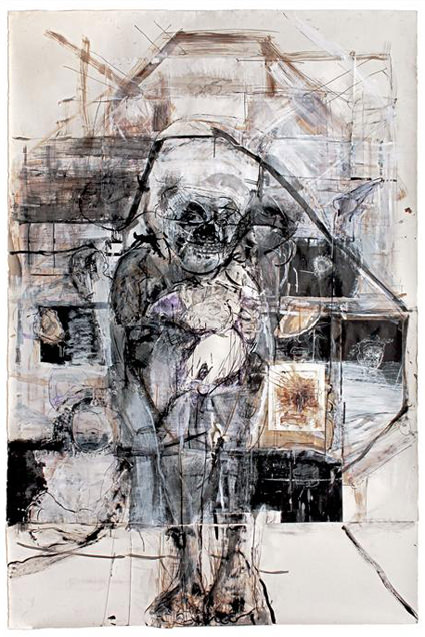
This most recent body of work comes after seeing Pablo Picasso’s Guernica, which she visited for the first time three years ago. As a result, Glantzman’s work began to shift away from her typical introspective self-portraits toward a more encompassing, outward exploration of war and its societal impact.

In a statement on the new work, Glantzman states:

“All of my work is like a flashlight on the dark underbelly that exists under the surface of polite society. The United States is engaged in wars without any impact on our daily life. My work always had the macabre, and I wanted to marinate in my natural impulse, no holds barred. I felt that I understood the language of the psychological self-portrait and I wanted to try to invent a new language for myself.”

The individual images interact with each other exposing the horrors and diversity of war. She continues:

“I approached the work with collage. What did one image look like next to an entirely different image: one might be made from observation- an image of something that symbolized war and death- a skull, other bones, guns. I tried, in a series of small canvas mounted with paper, various motifs like a mourner over a coffin. The hope was that, in combination, the pieces would yield greater meaning than the individual parts, that, as an artist, I was creating the stage with room for the viewer to locate his/her own associations.”

Exhibition runs through to May 11th, 2013

Betty Cuningham Gallery
541 West 25th street
New York
NY
10001
www.bettycuninghamgallery.com


NATHAN MABRY – SHAPESHIFTER

Posted on 2013-04-15

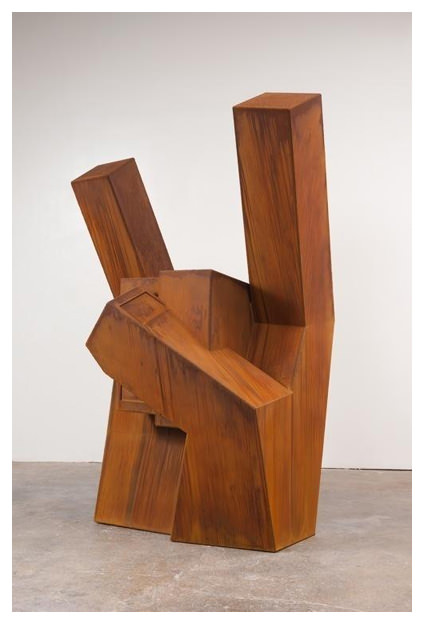
Mabry’s Heavy Handed (Separation Anxiety) and Heavy Handed (Tocca Ferro/Horns Up) will be presented in gallery two. The Heavy Handed works are large-scale sculptures made of steel that resemble block-like human hands, making gestures ranging from the benign to the profane. They reference sign language, colloquial symbols and other forms of gestural communication that can be simultaneously illustrative and provocative.

In gallery three, Mabry will exhibit his newest series of work, which comprises oversized terra-cotta heads resting atop aluminum bases that reference minimalist sculpture, specifically Donald Judd’s milled aluminum works. The heads, hand-sculpted by Mabry, are derived from architectural elements – tenon heads found at Chavín de Huántar, a pre-Columbian religious and political site built by the Chavín people in Peru. The Chavín religion involved human to animal transformation, or shapeshifting, achieved through the use of hallucinogenic drugs. Mabry’s heads incorporate animals commonly associated with Chavín iconography, specifically jaguars, eagles and snakes.

The stark contrast of these ancient figurative forms to the cool reserve of their abstract minimalist bases creates, in Mabry’s words, a “crashing together” of cultural aesthetics; this juxtaposition of ancient and contemporary is a common theme in Mabry’s oeuvre.

Opposite – Heavy Handed (Tocca Ferro/Horns Up), 2013

Exhibition runs through to May 4th, 2013

Sean Kelly Gallery
475 Tenth Ave
New York
NY
10018

www.skny.com


HUGO CANOILAS – MAGMA

Posted on 2013-04-15

With its foundations in painting, Canoilas’ work is often collaborative and incorporates video, sound, sculpture and performance as well as research-based projects. Over the last decade painting has led him to establish a dialogue between abstraction and a style that nods towards social realism. With a strong interest in modernism and literature, Canoilas’ practice revisits histories from a political, poetic, religious or existentialist perspective and has a capacity to be in a limbo between some of these subjects.

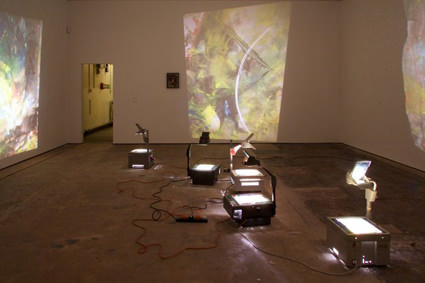
For the past 3 years Canoilas has been collecting pages from free newspapers both at home and whilst travelling. Each page is selected either because of his inability to understand or comprehend the content both in terms of language and subject. These pages then form the ground for a series of paintings made ‘blind’ in which Canoilas presses the paper face down into paint. For Workplace Gallery, Canoilas has collaged a collection of these works by overlaying specifically selected and framed works with paintings projected from transparencies on analogue overhead projectors.

For his recent installation Paradise Birds – at 30th São Paulo Biennial – Canoilas created a series of epic scaled paintings on unframed, unprepared canvas using a process of dipping, staining, and drawing in Ink rather than paint. Depicting characters who first explored the interior territories of Brazil the paintings move between figuration and abstraction, performance and propaganda calling into question the status of both the works as art objects and their subjects as either national hero or political tools.

Exhibition runs through to May 4th, 2013

Workplace Gallery
The Old Post Office
19/21 West Street
Gateshead
NE8 1AD

www.workplacegallery.co.uk


ESTHER STOCKER

Posted on 2013-04-15

Esther Stocker’s modernist form language manifests itself in a variety of artistic media, addressing a theme that dates back to the abstraction of painting in the early 20th century, when Kasimir Malevich’s Black Square on White (1915) transferred painting to the non-representational realm and introduced a spatial dimension. The departure of painting towards a three-dimensional approach that goes beyond figurative representation created a wider range of possibilities to view art as a holistic experience of philosophical issues.

In her works, Stocker uses diverse media to address the resumption of a Malevichian discourse on abstraction geared to the theory of space. The artist systematically checks the validity of the two-dimensional logic of imagination in painting and breaks up its spatial limitations. By using black-and-white patterns and textures, she releases the viewer from the perception of colour and draws their attention directly to spatial structures. Stocker’s artistic work deals with the juxtaposition of painting, photography and sculpture as an interaction between theories that encompass all spatial dimensions.

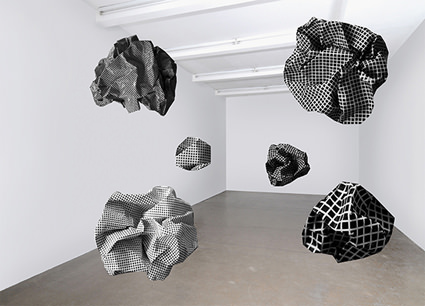
In her most recent works, black squares in grid patterns are transferred in a repetitive form onto the surface of objects that are suspended in space. By folding and creasing the original paintings on paper, she creates “clusters” or reliefs on the wall. The process of creasing the black-and-white grid patterns creates a distorted array of variously arranged squares, thus also alluding to instances of Op Art and subsequently transferring them into the three-dimensionality of space.

Exhibition runs through to June 1st, 2013

Krobath
Eschenbachgasse 9
A – 1010 Vienna
Austria

www.galeriekrobath.at


DANIEL GORDON – THE GREEN LINE

Posted on 2013-04-08

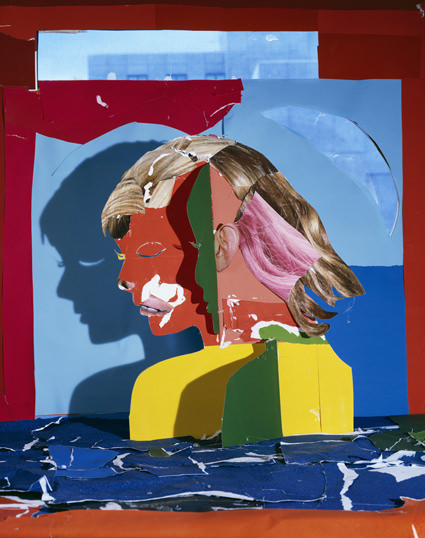
In Gordon’s practice, the artist culls photographic images from the Internet, prints them out and uses them to build three-dimensional tableaus. He then photographs these tableaus with an 8 x 10 inch view camera. Afterward, the sculptures are dismantled, though their various elements – body parts, colors, background patterns – are often reused to make new works.

Gordon’s melding together of fragmented parts form a dislocated reality where different perspectives, profiles and people merge into an incongruous whole. Through the process of slicing, cutting, gluing, staging, arranging and recycling, Gordon executes a shift from digital to analogue – almost as though he were engaged in a physical form of Photoshop—and challenges the stability of the fixed image, opening up the possibility for new meanings to emerge. This unique handling of the photographic medium connects Gordon with the history of collage and painting. In these works red, yellow and blue dominate in bold blocks. Visibly torn edges, gobs of glue and raw, recycled scraps fuse and separate before our eyes, wavering between completion and dissolution.

Exhibition runs from May 18th to June 29th, 2013

M+B
612 North Almont Drive
Los Angeles
CA
90069

www.mbart.com


ASHLEY BICKERTON & NICOLAS POL

Posted on 2013-04-08

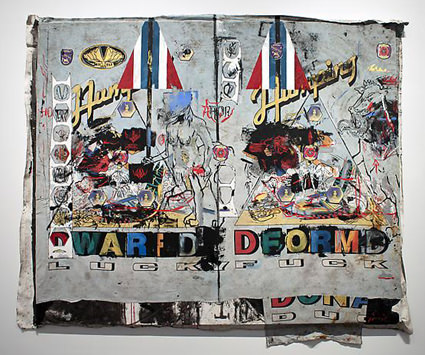
The exhibition presents a dialogue between two distinctive and wildly imaginative artists, born of different generations, who draw upon a similar reactive nature to construct vibrant, fantastical, and often times, otherworldly images of apocalyptic proportion.

Ashley Bickerton’s work from the late 80s and early 90s was fueled by a critical assessment of America’s obsession with consumerism; created in reaction to the sleek packaging, corporate branding, and growing reliance on technology that dominated the cultural landscape at the time. His object-based sculptures, or “Culture-scapes,” from this period were angry, defiant constructions covered in logos and seemingly built to withstand apocalyptic devastation.

Nicolas Pol spent much of his childhood in Africa before relocating to France, where he earned his degree from the prestigious École Nationale Supérieure des Beaux-Arts, La Sorbonne. Following two successful solo shows at Alsopp Contemporary in London, Vladimir Restoin Roitfeld presented Pol’s work in three large-scale international exhibitions: The Martus Maw, New York (2009); The Mother of Pouacrus, London in (2010); and Sick Atavus of the New Blood, New York (2011).

Exhibition runs through to April 20th, 2013

Lehmann Maupin
201 Chrystie Street
New York
NY
10002

www.lehmannmaupin.com